

Dopant Activity for Highly In-Situ Doped Polycrystalline Silicon: Hall, XRD, Scanning Capacitance Microscopy (SCM) and Scanning Spreading Resistance Microscopy (SSRM)
(高度原位掺杂多晶硅的掺杂剂活性:霍尔测量、X射线衍射(XRD)、扫描电容显微镜(SCM)与扫描扩展电阻显微镜(SSRM))
Rosine Coq Germanicus, Florent Lallemand, Daniel Chateigner, Wadia Jouha, Niemat Moultif, Olivier Latry, Arnaud Fouchet, Hugues Murray, Catherine Bunel, Ulrike Lüders
Abstract
Progressing miniaturization and the development of semiconductor integrated devices ask foradvanced characterizations of the different device components with ever-increasing accuracy.Particularly in highly doped layers, a fine control oflocal conduction is essential to minimize accessresistances and optimize integrated devices. For this,electrical Atomic Force Microscopy (AFM) areuseful tools to examine the local properties at nanometric scale, for the fundamental understanding ofthe layer conductivity,process optimization during the device fabrication and reliabilityissues. Byusing Scanning Capacitance Microscopy (SCM) and Scanning Spreading Resistance Microscopy(SSRM), we investigate a highly in situ doped polycrystalline silicon layer, a material where theelectrical transport properties are well known. This filmis deposited on aoxidelayer as a passivatingcontact. The study of the nano-MIS (SCM) and nano-Schottky (SSRM) contacts allows to determinethe distribution and homogeneity of the carrier concentration (active dopants), especially byinvestigating the redistribution of the dopants after an annealing step used for their activation. Whilethe chemical analysis by Secondary Ions Mass Spectroscopy (SIMS)quantifies only the dopantconcentration in the polycrystalline layer, the comparison with macroscopic characterizationtechniques as Hall effect measurements, supported with XRD characterization, shows that carefulSCM and SSRM measurements can be used to highlightthe dopantactivation. This analysis gives acomplete investigation of thelocalelectrical properties ofthe passivating contact when the parameters(applied voltages and applied forces) ofthe AFM nano-contacts are correctly controlled.
---
Summary of the Paper
Research Objective:
This study aims to characterize the dopant activation and uniformity in highly in-situ doped polycrystalline silicon (poly-Si) layers, a critical component in semiconductor devices like MOSFETs and solar cells. The goal is to evaluate how different annealing conditions affect dopant distribution and electrical properties, using a multi-technique approach to overcome limitations of traditional methods.
Methodology & Experimental Setup:
- Techniques Used: Hall measurements for bulk carrier concentration, X-ray diffraction (XRD) for structural analysis, scanning capacitance microscopy (SCM) for carrier profiling, and scanning spreading resistance microscopy (SSRM) for nanoscale resistance mapping.
- Sample Preparation: Poly-Si films were in-situ doped with phosphorus during deposition, followed by annealing at varying temperatures to activate dopants. Cross-sectional samples were prepared for SSRM to enable 2D resistance imaging.
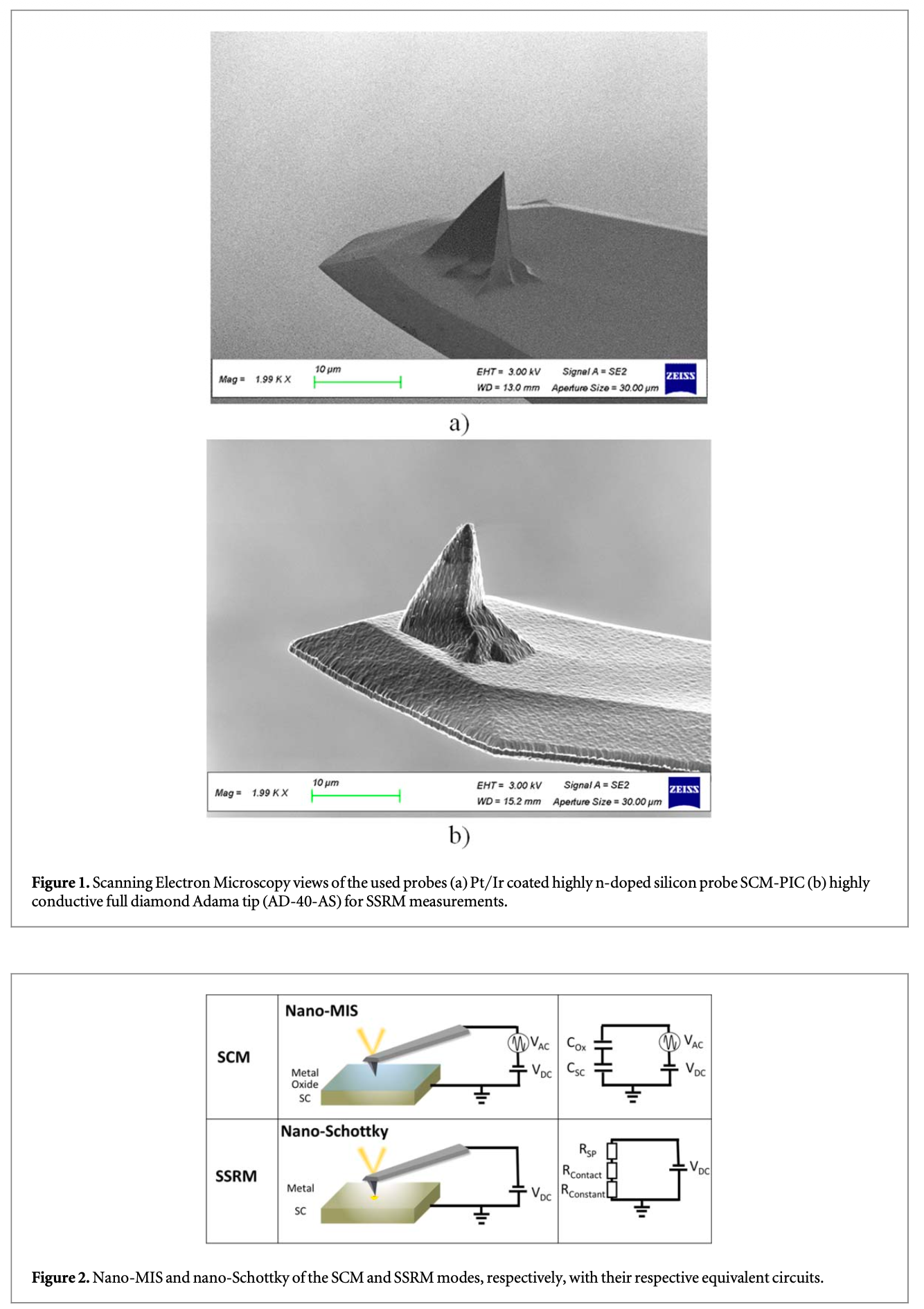
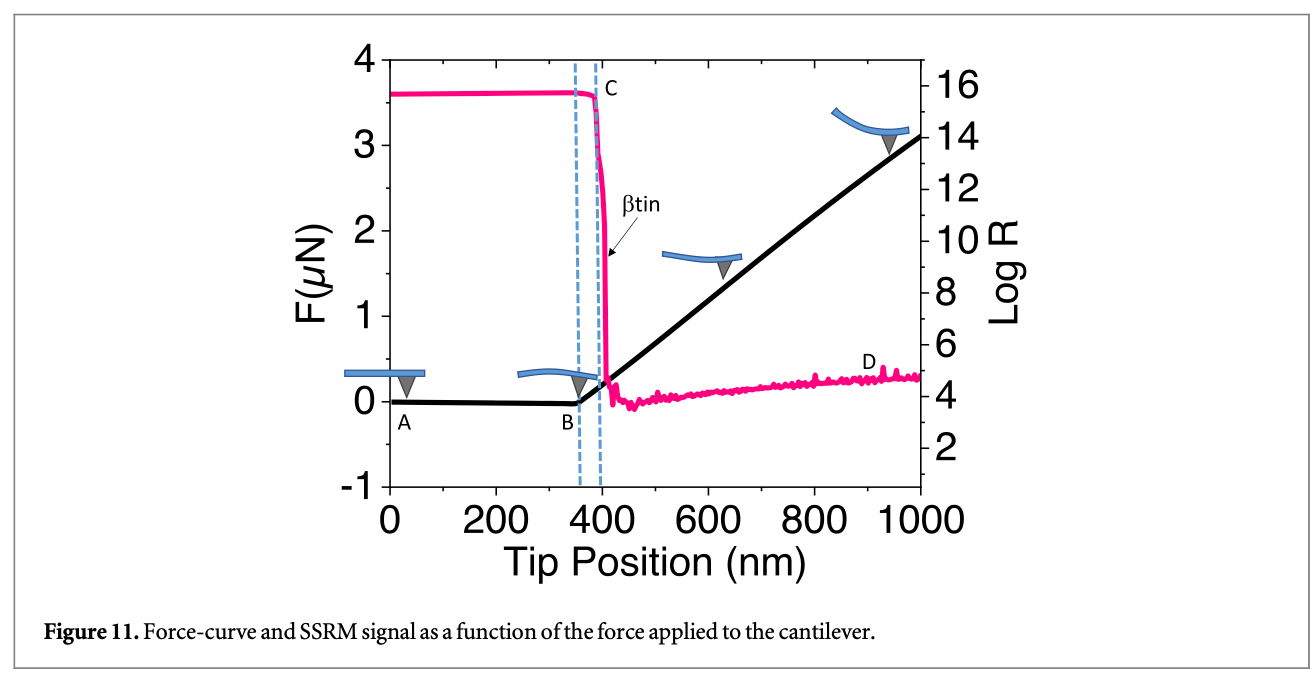
- SSRM Setup: A conductive atomic force microscopy (CAFM) probe with diamond coating was employed to ensure consistent tip-sample contact. Measurements involved applying a DC bias (low voltage) while scanning, with resistance values logged via a logarithmic amplifier. Scan sizes were typically 1.5 μm × 1.5 μm, focusing on interfaces like SiO₂ and Si substrate layers.
Key Findings:
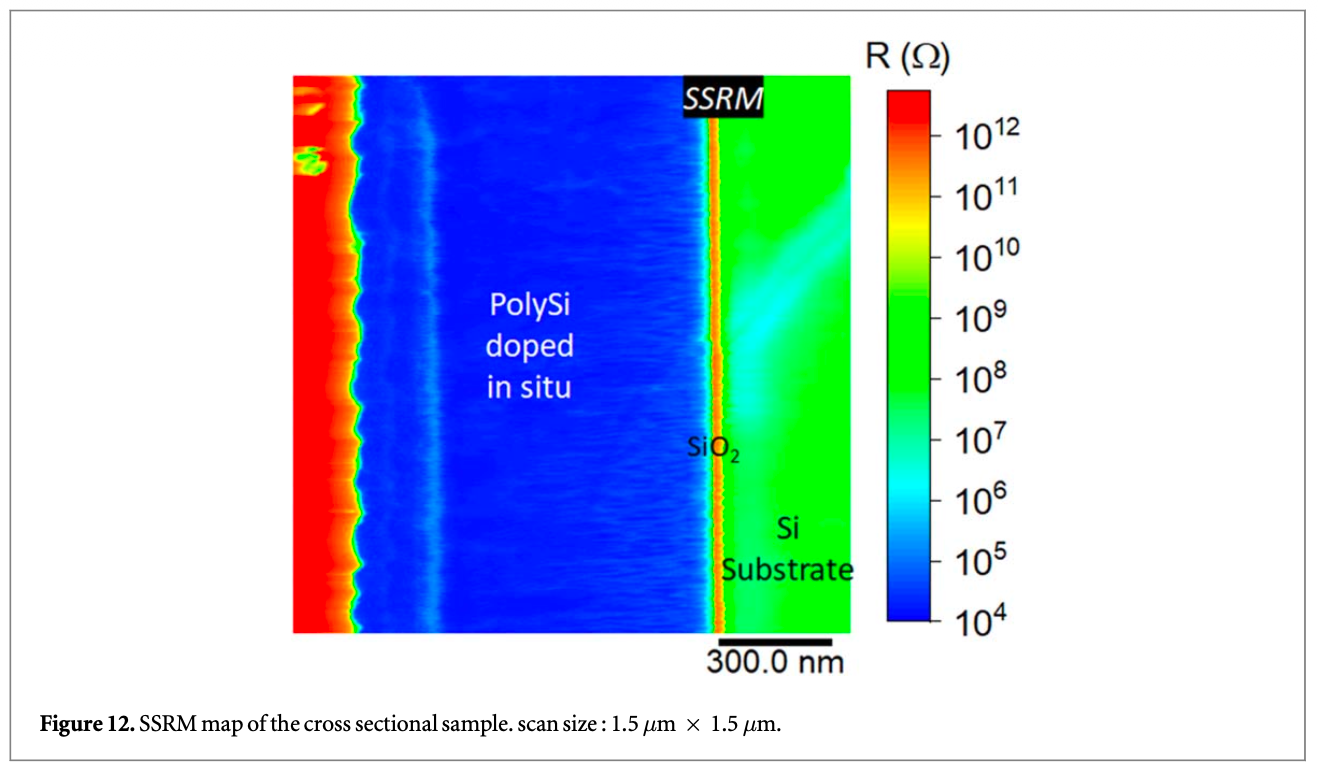
- SSRM revealed significant resistance variations across the poly-Si layer, with high-resistance regions (-10^12 Ω, indicating poor dopant activation) and low-resistance regions (-10^4 Ω, indicating effective activation), correlating with annealing-induced defects.
- The study identified a charge-depleted zone at the poly-Si surface after annealing, attributed to an oxide layer that prevents dopant out-diffusion. This was undetectable by Hall or XRD alone, highlighting SSRM's sensitivity to localized electrical properties.
- Compared to SCM, SSRM provided higher spatial resolution (-10 nm) and better dynamic range for resistance mapping, enabling precise detection of dopant clustering and interface issues. However, the technique required careful control of tip force to minimize noise and ensure repeatability.
---
SSRM 在研究中的运用:
在该研究中,扫描扩展电阻显微镜(SSRM)被用于原位掺杂多晶硅层的横截面电阻分布成像。通过应用金刚石涂层探针和低电压偏置,SSRM 生成了纳米级分辨率的电阻图(如 Figure 12 所示),直观展示了掺杂剂激活的不均匀性:高电阻区域(约 10^12 Ω,红色)对应低激活效率,而低电阻区域(约 10^4 Ω,蓝色)表示有效激活。这帮助识别了退火过程中形成的界面缺陷和电荷耗尽层,例如在 SiO₂ 层附近观察到的电阻异常。
技术价值与意义
SSRM 在该研究中的技术价值在于提供了非破坏性的二维电阻映射,空间分辨率达纳米级,克服了传统霍尔测量(仅提供体平均数据)和 XRD(仅限结构分析)的局限。这使研究人员能够精确量化掺杂均匀性,优化半导体工艺(如退火温度控制),从而提升器件性能(如降低 MOSFET 的接触电阻)。此外,SSRM 的高灵敏度有助于早期检测材料缺陷(如掺杂剂聚集),减少生产废品率,对先进半导体制造(如 FinFET 和太阳能电池)具有重要应用价值。
---
原文链接:DOI:10.1088/2632-959X/abed3e

