

Quantitative Scanning Microwave Microscopy for Transfer Characteristics of GaN High-Electron-Mobility Transistors
Xiaopeng Wang , Kazuki Nomoto, Gianluca Fabi, Marco Farina , SeniorDebdeep Jena , Huili Grace Xing and James C. M. Hwang
Abstract
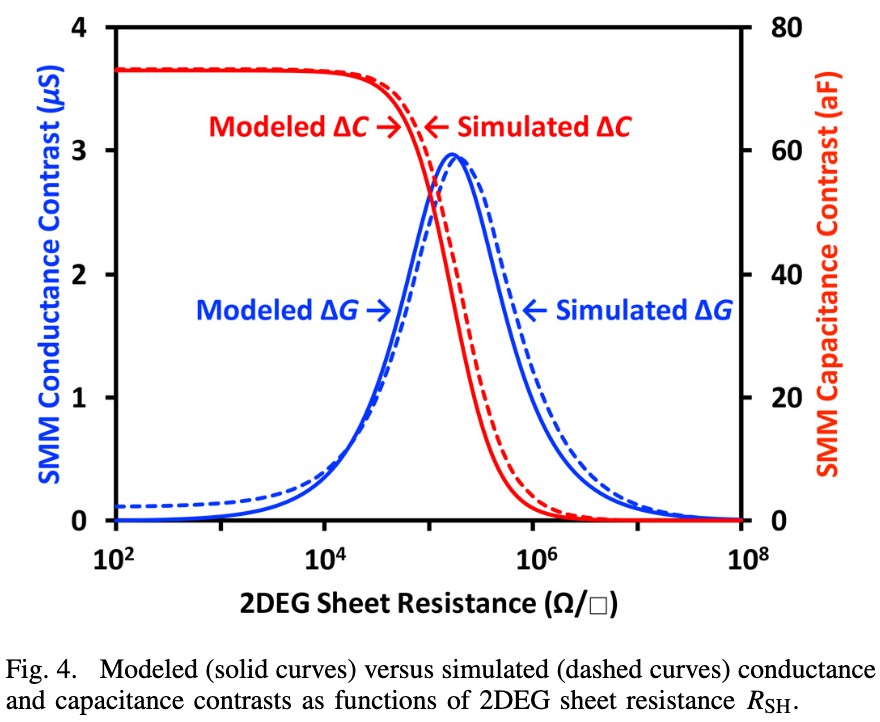
This article demonstrates the feasibility of using a scanning microwave microscope (SMM) to probe the transfer characteristics of an ungated GaN high-electron-mobility transistor (HEMT). To guide the experiment and to interpret the results, an equivalent circuit is proposed to model the probe-sample near-field interaction, and the model is validated by simulation and experimentation. In the experiment, the SMM probe with a DC bias voltage acts as a surrogate gate to locally modulate the two-dimensional electron gas (2DEG) at the GaN heterojunction. Because the present SMM is most sensitive to a 2DEG sheet resistance RSH between 10^4 ohms per square and 10^6 ohms per square, the unbiased RSH is determined to be (3 ± 3) × 10^3 ohms per square, in contrast to approximately 450 ohms per square determined by Hall measurements. However, as the bias decreases from 0 to −8 V, the 2DEG is depleted and its resistance increases to (5 ± 2) × 10^5 ohms per square, with an on/off ratio of 160, a peak transconductance around −5 V, and a threshold voltage of −6 V. These results agree with DC-measured current–voltage characteristics obtained from a gated HEMT after fabrication is completed. This demonstrates that SMM can be a powerful tool for in-process monitoring and material and device correlation.
Summary of the Paper
1. Research Objective
The study investigates the feasibility of using Scanning Microwave Microscopy (SMM) to quantitatively characterize the electrical properties of ungated GaN High-Electron-Mobility Transistors (HEMTs). The goal is to provide a non-destructive, in-process monitoring tool that can measure carrier concentration and transfer characteristics at the nanoscale before the final device fabrication is completed.
2. Methodology & Experimental Setup
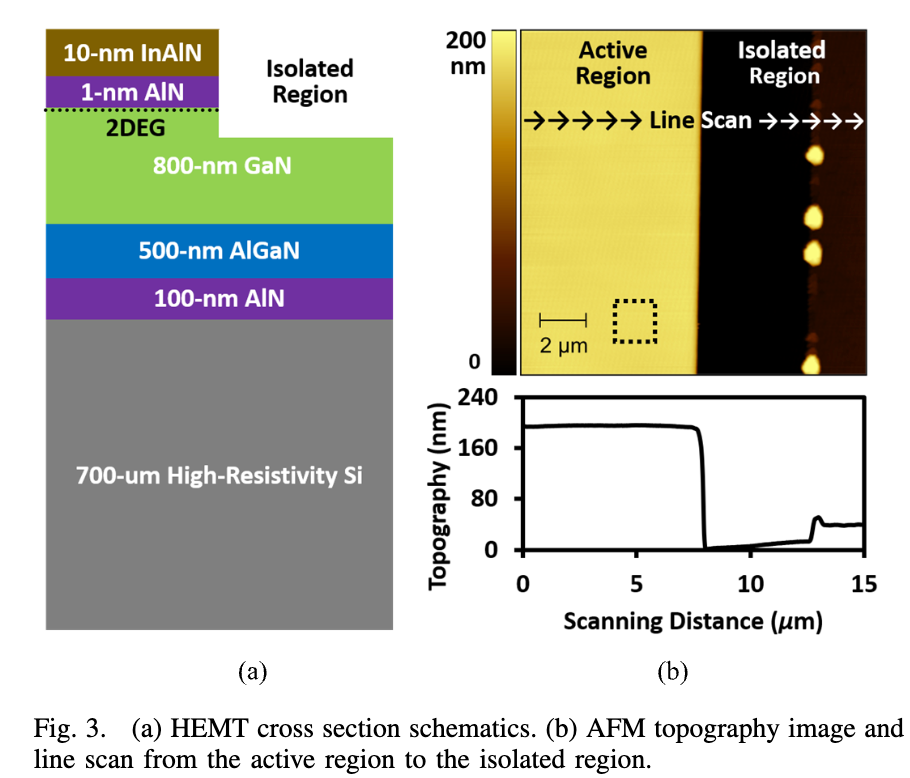
- System: A Keysight 7500 AFM integrated with an N9545C SMM module.
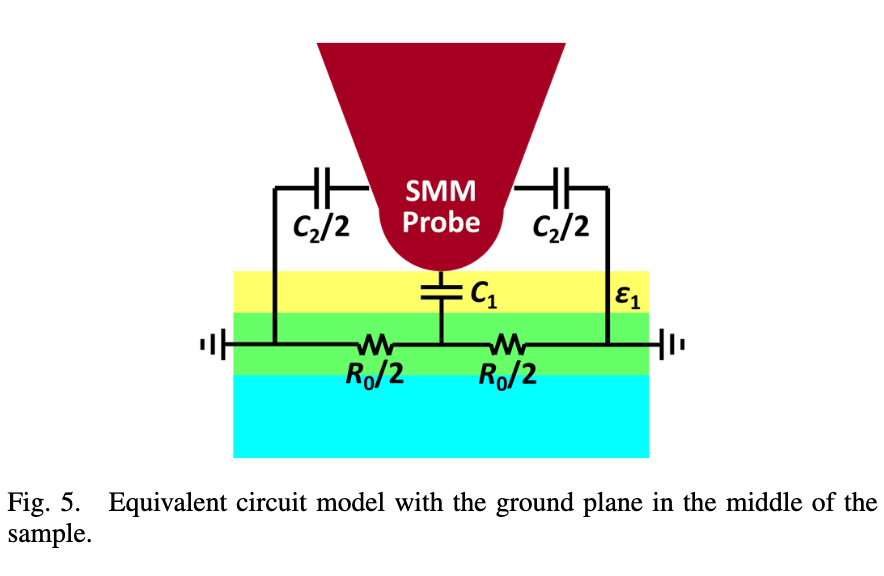
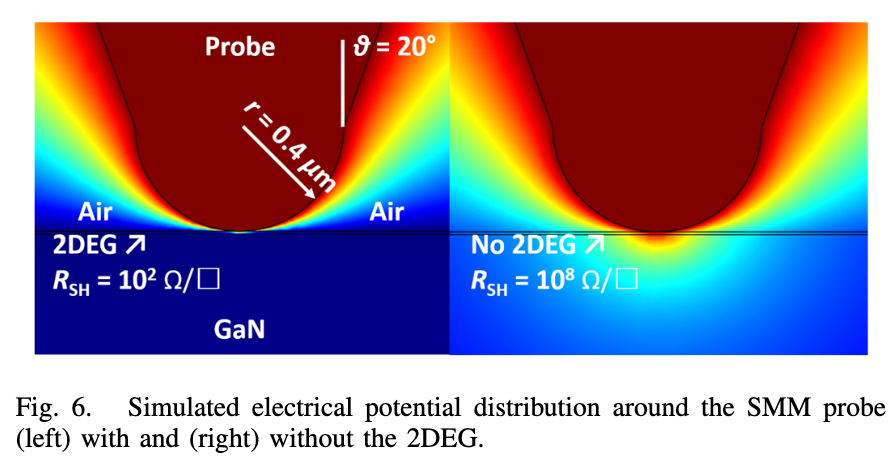
Probe: A platinum-coated probe (Rocky Mountain 25Pt300A) was used as a surrogate gate. - Modeling: The team developed a three-element equivalent circuit model (C1, C2, and G0) to represent the probe-sample interaction, validated through COMSOL Multiphysics simulations.
- Measurement: By applying a DC bias (VGS) to the SMM probe while measuring the microwave reflection coefficient (S11), the researchers extracted the local 2DEG sheet resistance (RSH) and simulated the device's transfer characteristics.
3. Key Findings
- Sensitivity Range: The SMM system demonstrated peak sensitivity for 2DEG sheet resistance between 104Ω/□104Ω/□ and 106 Ω/□106Ω/□.
- Quantitative Accuracy: The SMM-extracted threshold voltage (~ −6 V) and peak transconductance showed high correlation with DC measurements performed on fully fabricated gated HEMTs.
- Defect Mapping: The SMM successfully identified localized defects (likely screw dislocations) in the HEMT channel with submicrometer resolution, which were invisible in standard AFM topography or conventional DC testing.
【SMM核心用途】
- 转移特性定量提取:文献创造性地将带偏压的 SMM 探针作为“虚拟栅极”,在不制造实际金属栅极的情况下,提前测量 GaN HEMT 器件的转移曲线、跨导(gₘ)和阈值电压(Vₜₕ)。
- 2DEG 面电阻表征:实现了对 AlN/GaN 异质结界面二维电子气(2DEG)面电阻(Rₛₕ)的纳米级定量制图。
- 亚微米级缺陷定位:利用微波对电学特性的高敏感度,SMM 成功探测到了 2DEG 通道内部的局部缺陷(如位错),并分析了缺陷对迁移率和载流子浓度的具体影响,而这些缺陷在常规形貌扫描(AFM)中无法被发现。
【技术贡献与价值】
-
填补无损检测空白:传统的霍尔测试(Hall measurement)通常具有破坏性且空间分辨率低。本研究证明了 SMM 可以在器件加工的中间环节(In-process)进行非破坏性检测,大幅提升了工艺监控的效率。
-
建立定量化物理模型:论文提出并验证了一套适用于 HEMT 结构的 SMM 等效电路模型,解决了微波信号与半导体物理参数(电阻、电容)之间的转换难题,推动了 SMM 从“定性成像”向“定量测量”的跨越。
-
高空间分辨率的电学评价:相比于传统的非接触电阻率制图(毫米级分辨率),SMM 将 GaN 材料的电学评价提升到了亚微米级别,为优化宽禁带半导体外延片质量和器件设计提供了精确的数据支持
原文链接:https://djena.engineering.cornell.edu/papers-new/2024/wang2024quantitative.pdf#page=2.26

