

Quantitative scanning microwave microscopy of 2D electron and hole gases in AlN/GaN heterostructures

Abstract
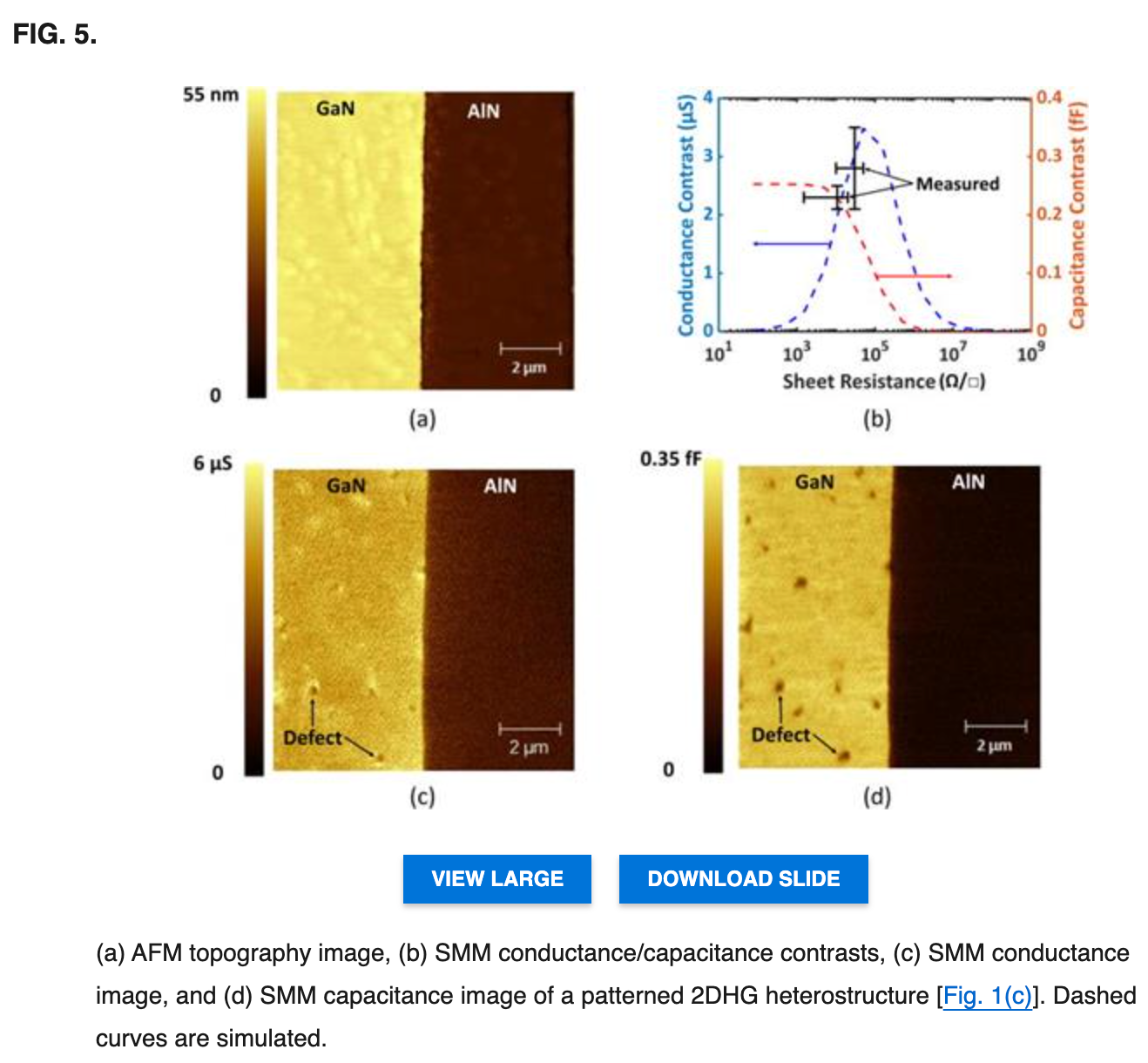
Although the scanning microwave microscope (SMM) is based on the atomic force microscope (AFM), the SMM differs from the AFM by being able to sense subsurface electromagnetic properties of a sample. This makes the SMM promising for in-depth nondestructive characterization of nanoelectronic structures. However, the SMM raw data are convoluted with the sample topography, making it especially challenging for quantitative characterization of nonplanar structures. In this paper, using the topography information simultaneously obtained by the AFM and the in situ extracted probe geometry, we de-embed from the topography-corrupted SMM data the sheet resistance of 2D electron or hole gas (2DEG or 2DHG) buried at the interface of an AlN/GaN heterostructure, including the lateral depletion of the 2DEG from an etched step. The SMM results are validated by Hall-effect measurements. The limitation and possible improvement in the present technique are discussed. With improved setup, the SMM can be used to nondestructively monitor the local sheet resistance of 2DEG or 2DHG during device manufacture. These studies help to pave the way to 3D microwave tomography on the nanometer scale.
Summary of the paper
This study presents a quantitative approach to characterizing the local electrical properties of two-dimensional electron gases (2DEGs) and hole gases (2DHGs) in AlN/GaN heterostructures using Scanning Microwave Microscopy (SMM). The authors address the long-standing challenge of separating topographic artifacts from genuine electronic signals in near-field microwave measurements.
Key Methodologies:
1. SMM Implementation: The researchers utilized an Atomic Force Microscope (AFM) interfaced with a Vector Network Analyzer (VNA) operating at microwave frequencies (approx. 19 GHz). This setup measured the complex reflection coefficient (S11) of the probe-sample system.
2. Finite-Element Modeling (FEM): To convert raw SMM signals into physical quantities, 3D FEM simulations were conducted. These simulations modeled the electrostatic interaction between the metallic tip and the semiconductor stack, accounting for the tip's geometry (radius and cone angle).
3. Topography De-embedding: A critical contribution of this work is the development of a calibration workflow that decouples the capacitive topography signal (variations caused by surface roughness) from the impedance signal of the buried conductive channels.
Key Findings:
• The study successfully mapped the local sheet resistance (R_sh) of the buried 2DEG/2DHG layers at the nanoscale.
• The local R_sh values derived from SMM were in excellent agreement with macroscopic Hall effect measurements, validating the quantitative accuracy of the method.
• The technique effectively visualized conductivity variations in undoped AlN/GaN heterostructures, confirming the simultaneous presence of mobile electrons and holes induced by polarization.
Conclusion:
The paper establishes SMM as a robust, non-destructive metrology tool for wide-bandgap semiconductors, capable of providing quantitative feedback on carrier transport properties at resolutions inaccessible to standard electrical characterization methods.
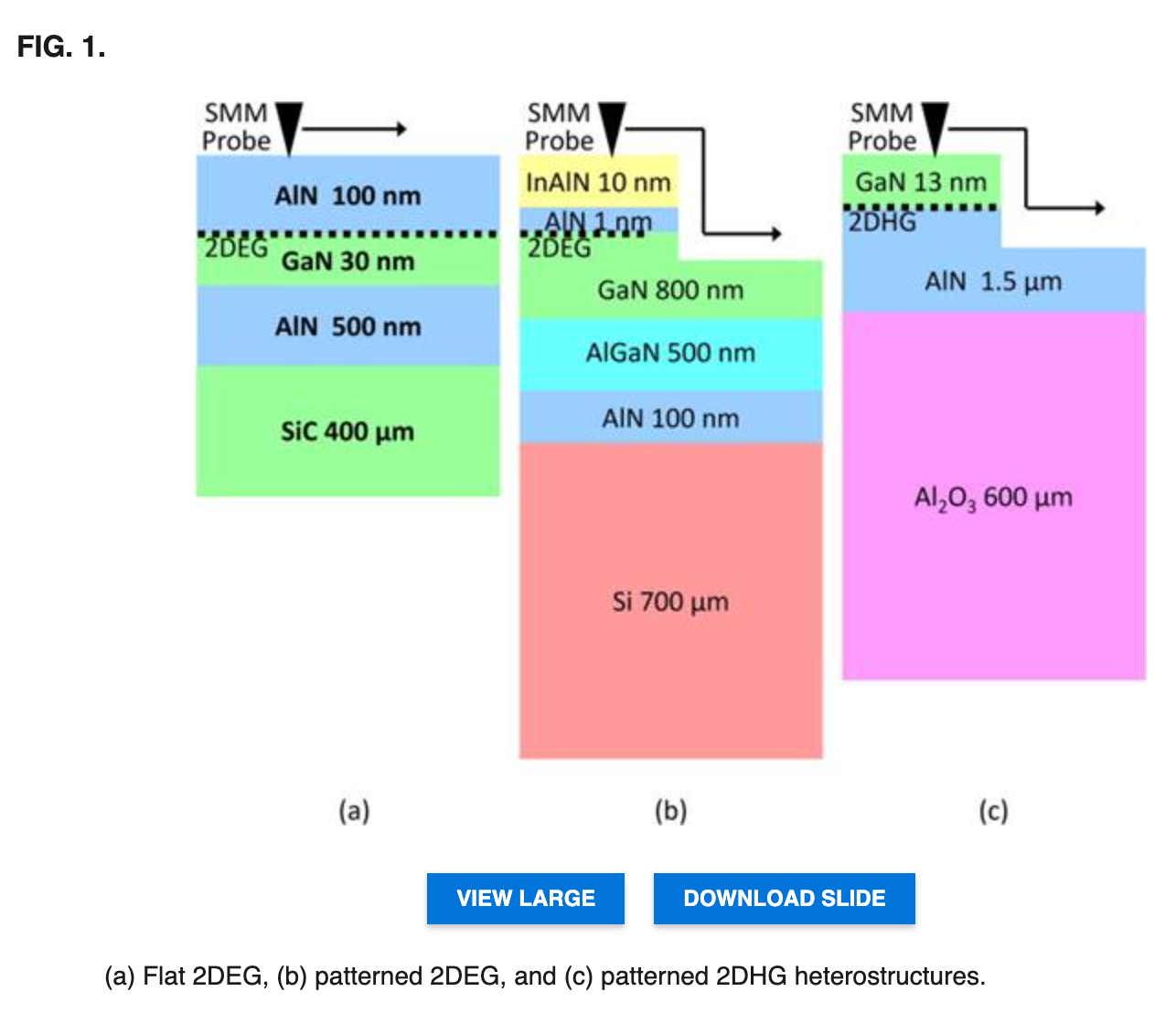
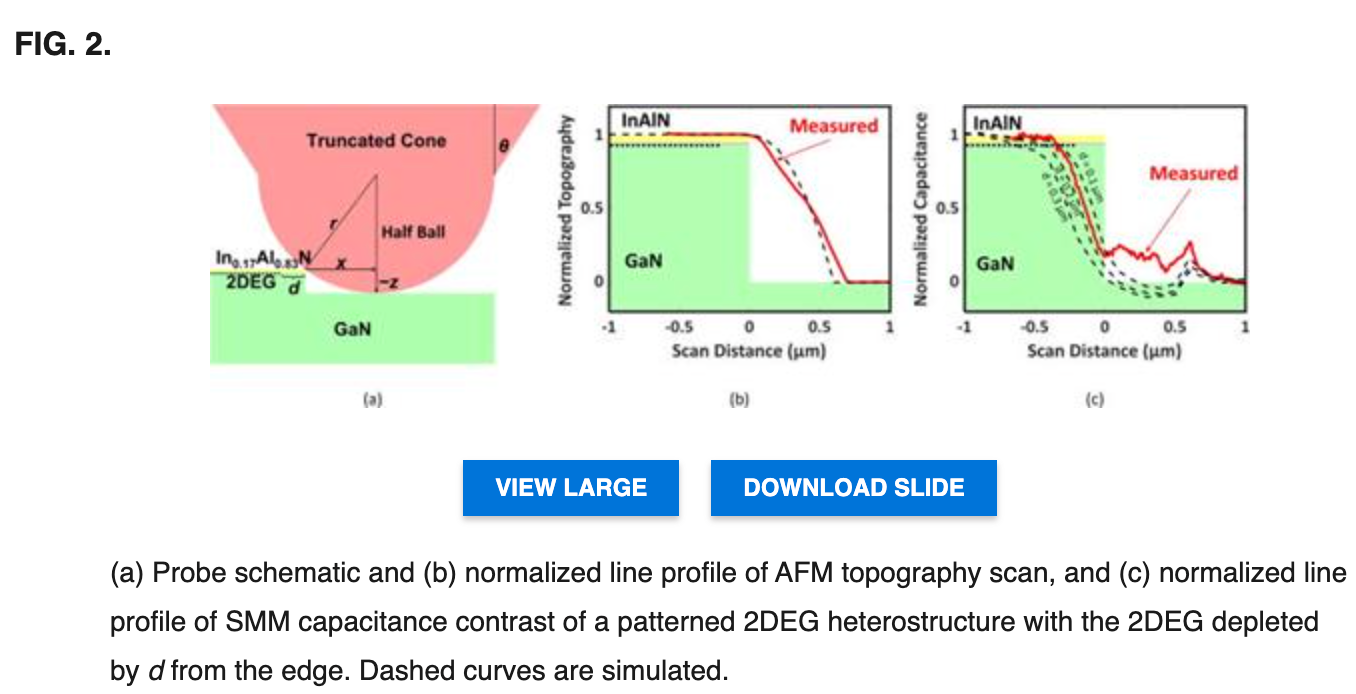
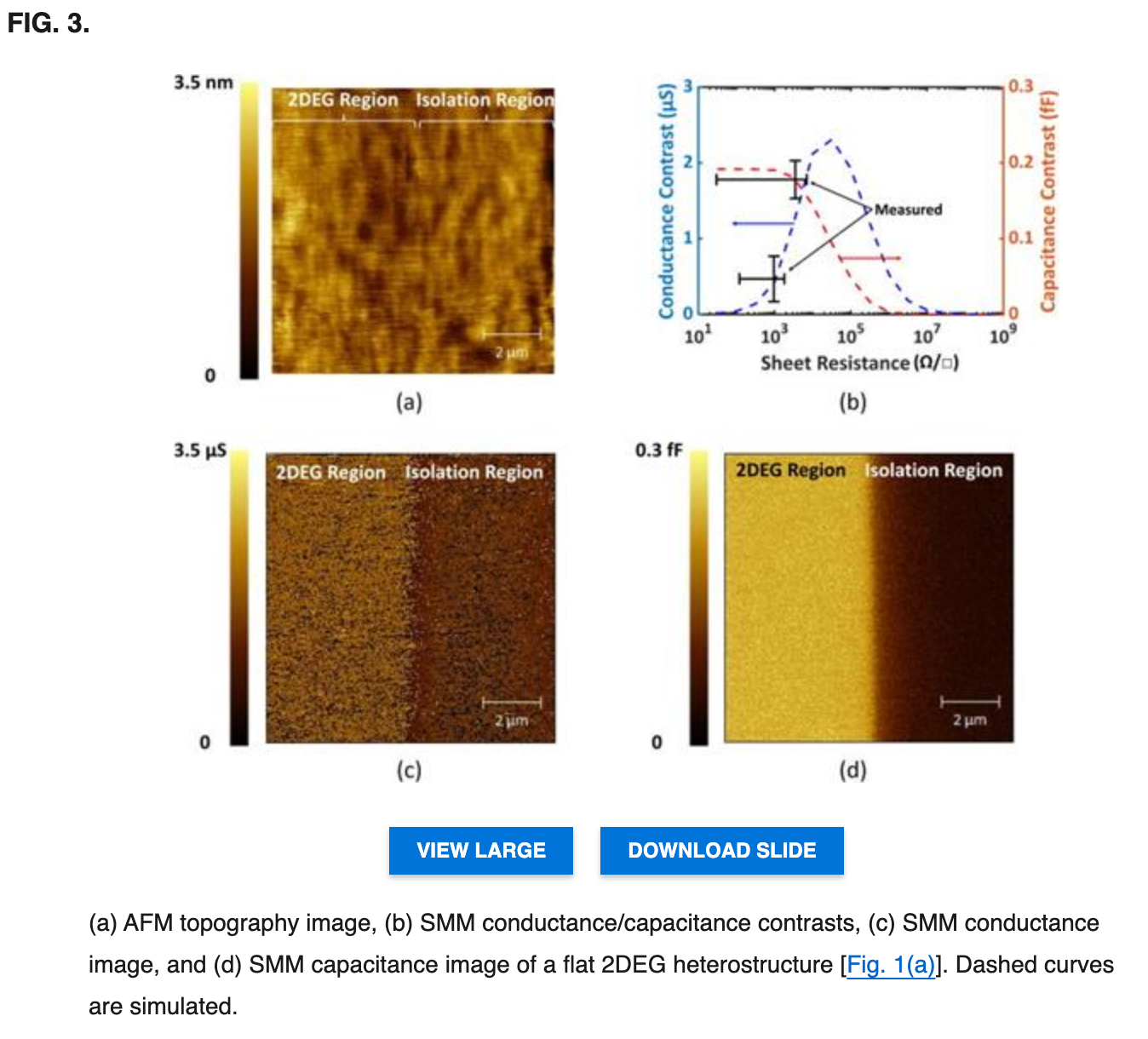
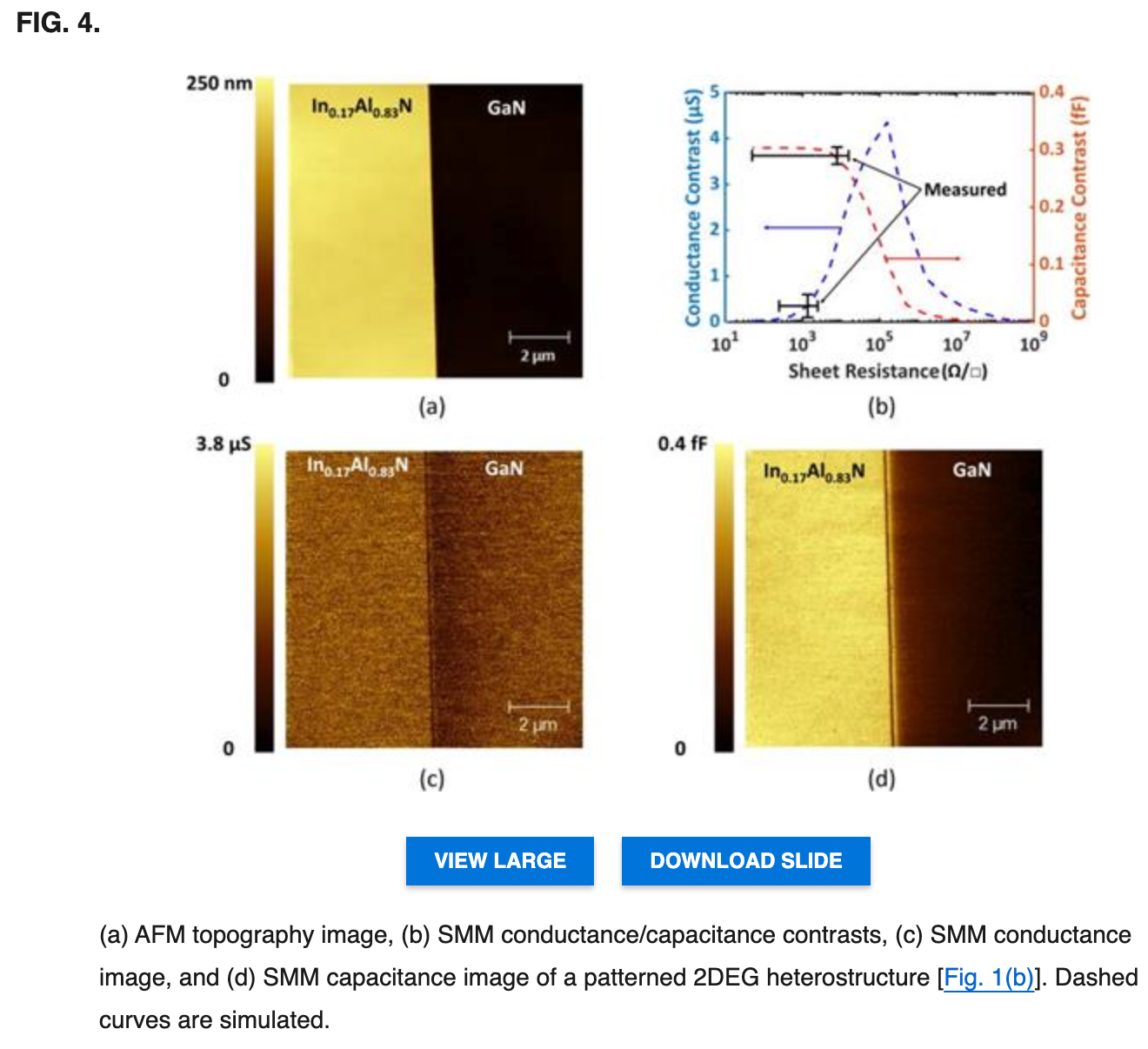
在这项研究中,SMM(扫描微波显微镜)不仅被用作一种成像工具,更被开发为一种高精度的定量计量工具。
1. SMM的具体应用与技术贡献
• 无损探测“埋层”载流子:
通常的导电原子力显微镜(C-AFM)需要探针与样品表面形成欧姆接触才能测量电流。然而,AlN/GaN器件表面通常覆盖着绝缘的AlN层。研究团队利用SMM的微波穿透能力,在无需去除表面绝缘层且不接触导电沟道的情况下,成功感应到了下方埋藏的二维电子气(2DEG)和空穴气(2DHG)。
• 攻克“形貌-电学信号串扰”难题:
SMM测量的最大难点在于,样品表面的高度起伏(形貌)会改变探针与样品的电容,从而产生虚假的电学信号。该研究提出了一套去嵌入(De-embedding)算法,结合有限元模拟(FEM),将形貌引起的电容变化从总信号中剥离,从而提取出纯粹由半导体内部载流子浓度变化引起的阻抗信号。
• 从定性成像到定量测量:
作者通过建立探针的物理模型,将SMM测得的微波反射参数(S11)转化为具体的物理参数——方块电阻(Sheet Resistance)。这意味着SMM不再只是“看哪里亮、哪里暗”,而是能给出“这里的电阻是 XX Ω/sq”的具体数值。
2. 实践意义与行业价值
这项研究对半导体(尤其是第三代半导体GaN、SiC等)的研发与生产具有重要的实践意义:
• 纳米级工艺监控:
传统的霍尔效应测量(Hall Measurement)只能给出整块样品的平均电阻率。而SMM能以纳米级分辨率扫描样品,这使得研究人员可以看到晶圆内部的均匀性,例如发现由于外延生长缺陷导致的局部高阻区域。
• 器件边缘特性分析:
在微波器件制造中,器件边缘往往会因为损伤或非对称效应导致性能下降。该研究展示了SMM能够清晰地区分出器件边缘的耗尽区宽度,这对于优化高频射频器件(RF Devices)的结构设计至关重要。
• 非破坏性失效分析:
由于SMM不需要破坏样品表面,也不需要制作复杂的测试电极,它可以用作昂贵外延片(Wafer)出厂前的快速无损检测手段,极大降低了研发过程中的测试成本和时间成本。
原文:https://doi.org/10.1063/5.0072358

