

Degradation Processes in Positive Electrode Composites for All-Solid-State Lithium-Ion Batteries Visualized by Scanning Spreading Resistance Microscopy
Hirotada Gamo, Yasushi Maeda, Kentaro Kuratani, Yuji Yamagishi, Tetsu Kiyobayashi, Zyun Siroma, Nobuhiko Takeichi, Hikaru Sano
All-solid-state lithium-ion batteries (ASSLIBs) are promising next-generation energy storage devices because of their high safety and energy density. However, the performance of ASSLIBs is restricted by various degradation factors in positive electrode composites, including the structural changes in positive electrode materials, associated volume changes, and formation of solid-electrolyte decomposition products. Despite their importance, the individual effects of these factors are not well understood. Herein, the chemical and mechanical degradation processes in positive electrode composites with LiNi0.5Co0.2Mn0.3O2 (NCM) and argyrodite-type sulfide solid electrolytes are revealed using scanning spreading resistance microscopy. The results of local resistance analysis based on this technique demonstrate the appearance of electronically isolated NCM particles due to their volume shrinkage and the electronically conductive decomposition products generated from solid electrolytes at high potentials. These processes cause different degradation scenarios, namely rapid capacity loss during initial cycling and continuous capacity loss, respectively. The results of X-ray photoemission spectroscopy analysis indicate that the electronically conductive decomposition products are lithium thiophosphates with long-chain crosslinked sulfur. The study unveils the effect of contact loss between NCM particles and offers insight into the dynamic evolution of electrolyte decomposition layers within positive electrodes for ASSLIBs.
Summary of the paper
Scope and goal. This study investigates chemical and mechanical degradation in positive electrode composites of all‑solid‑state lithium‑ion batteries (ASSLIBs) composed of LiNi(NCM) and argyrodite‑type sulfide solid electrolyte (LPSCl), aiming to disentangle how structural changes, volume variation, and electrolyte decomposition individually affect cell performance.
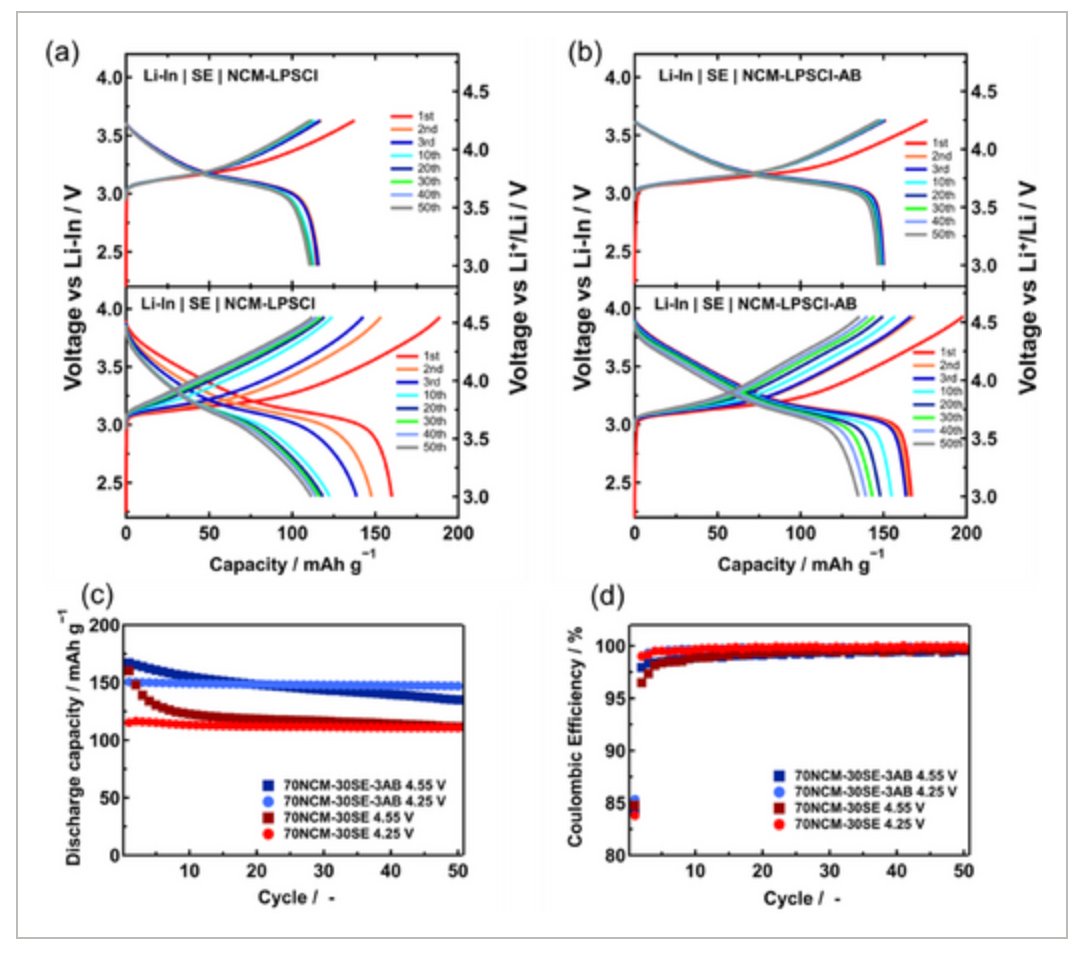
Key findings. Two distinct degradation scenarios were identified: (1) rapid initial capacity loss in composites without conductive additive (acetylene black, AB) caused by mechanical contact loss and electronic isolation of NCM particles after deep delithiation; and (2) continuous capacity fade in composites with AB driven by oxidative decomposition of LPSCl that produces lithium thiophosphates with long‑chain crosslinked sulfur, which are moderately electronically conductive and promote progressive interphase growth.
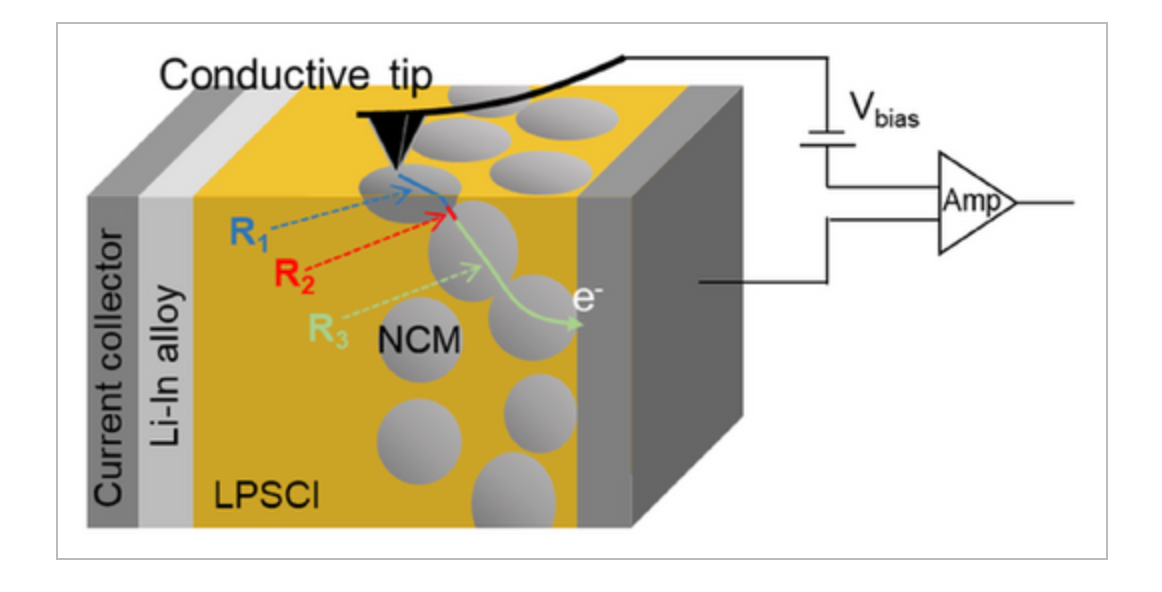
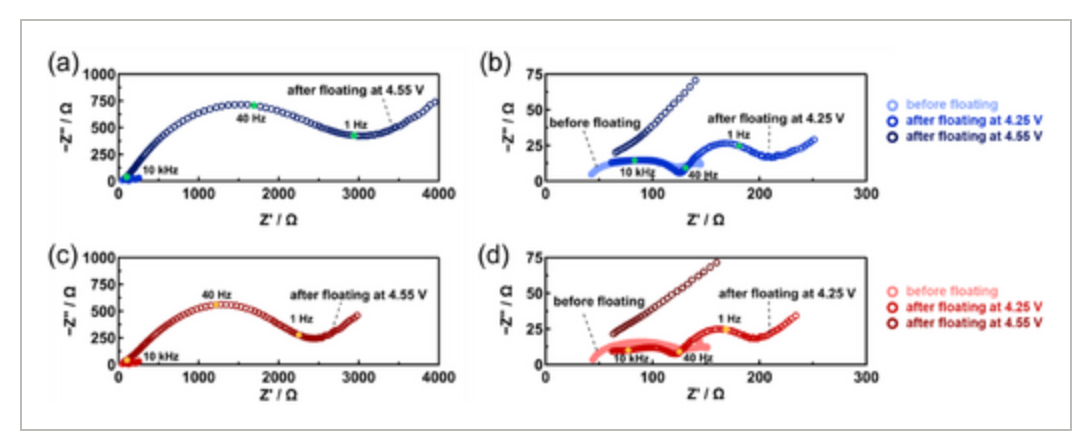
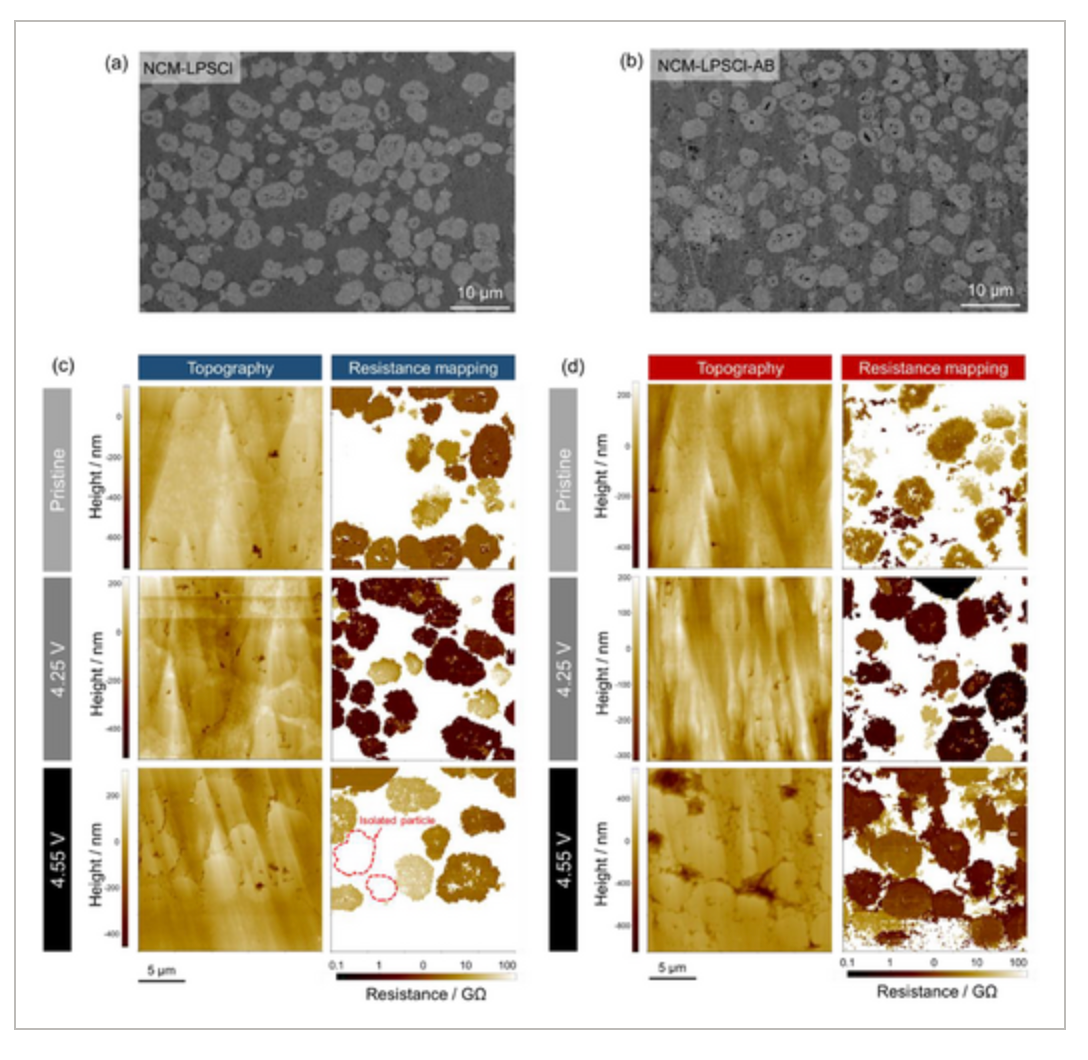
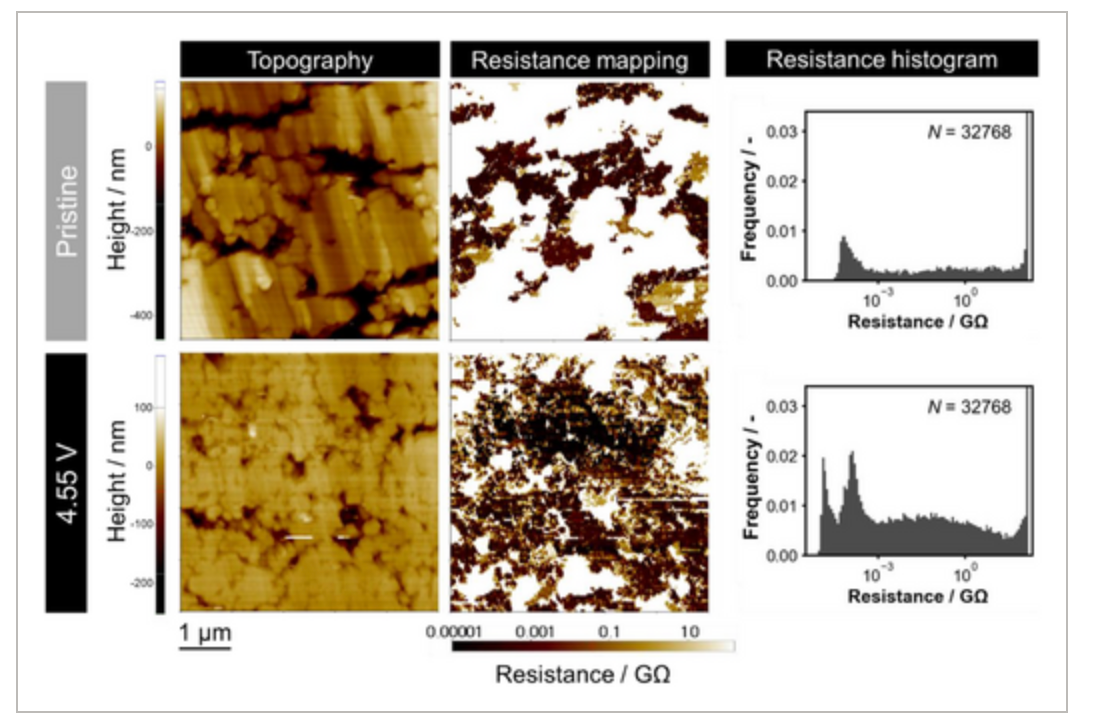
Methods and corroborating analyses. Scanning spreading resistance microscopy (SSRM) provided spatially resolved local resistance maps that revealed (a) increased local resistance and electronically isolated NCM particles after floating at high cut‑off potential (4.55 V) in NCM–LPSCl without AB, and (b) decreased local resistance of the SE region and suppression of NCM isolation in NCM–LPSCl–AB due to conductive decomposition products and AB networks. These SSRM observations were supported by electrochemical impedance spectroscopy (EIS), X‑ray diffraction (XRD), and X‑ray photoemission spectroscopy (XPS) analyses.
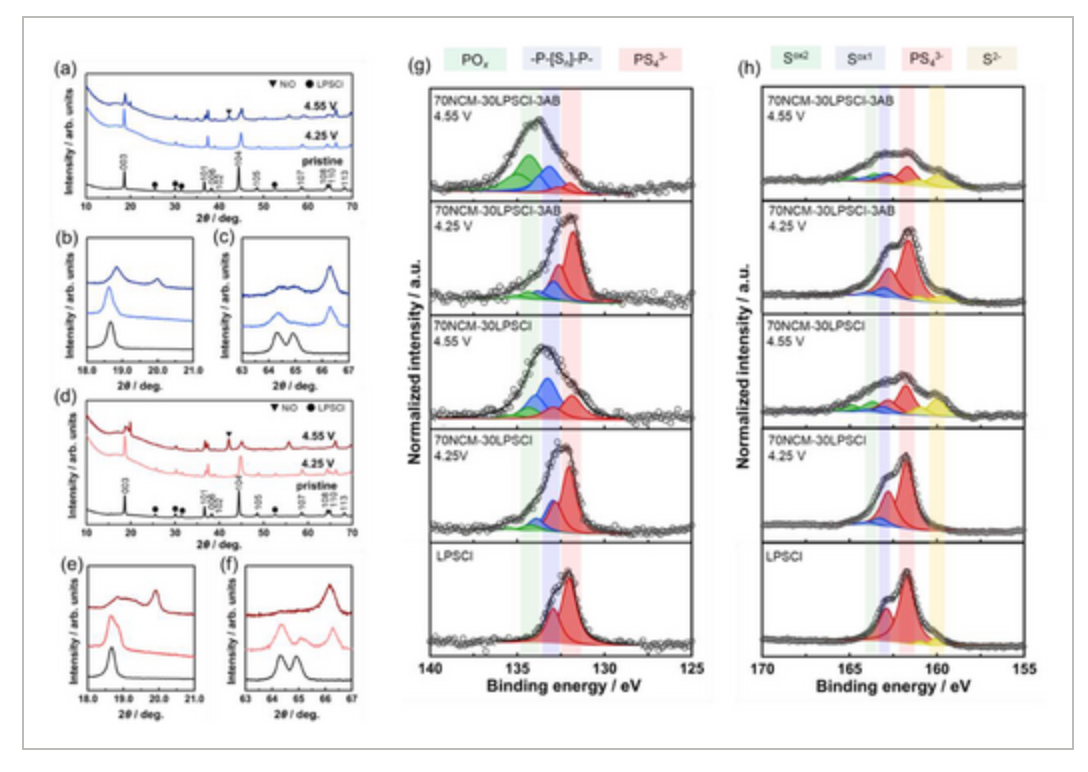
Mechanistic interpretation. XRD showed H2–H3 phase transitions and anisotropic volume shrinkage of NCM at high potentials, explaining increased contact resistance between particles. XPS identified oxidized sulfur and phosphorus species consistent with lithium thiophosphate formation; theoretical and experimental evidence indicates these products have moderate electronic conductivity, enabling electron transport through the interphase and accelerating continuous decomposition and capacity loss.
本文用 SSRM 结合 EIS、XRD、XPS 等手段,解析了 NCM/LPSCl 正极复合材料在高电位下的化学与机械退化机理,区分了无导电剂时的初期快速失效与有导电剂时的持续性衰减两种情形。
SSRM 的具体应用与贡献。
定位电阻变化:SSRM 在正极截面上绘制局域电阻图,直接显示出单个 NCM 粒子与周围导电网络的接触状况;在 4.55 V 浮充后,NCM–LPSCl(无 AB)出现局域电阻显著增大甚至超出检测范围的区域,表明部分颗粒被电子隔离,从而导致初期容量骤降。
识别导电分解产物的分布:在含 AB 的正极中,SSRM 发现原本绝缘的 LPSCl 区域在高电位后出现低电阻区域,与 XPS 识别出的含长链交联硫的锂硫磷化物一致,说明这些分解产物具有中等电子导电性并在电极内部形成新的电子通路,解释了持续性容量衰减的来源。
将微观电学信息与宏观电化学行为关联:SSRM 提供的 (探针下扩散电阻、颗粒间接触电阻、到集流体的网络电阻)分量视角,帮助将 XRD 指示的体积收缩与 EIS 中出现的中频阻抗成分联系起来,明确了机械接触丧失与界面化学分解在不同条件下的主导作用。
实践意义。 SSRM 的高空间分辨率电阻成像能直接可视化电子通路的形成与断裂,为设计抑制接触丧失或抑制导电分解产物生成的正极配方(例如优化导电剂用量、界面涂层或电位窗口)提供了明确的微观证据与改进方向.
原文链接:https://onlinelibrary.wiley.com/doi/10.1002/smtd.202500080

